Stoicism 101
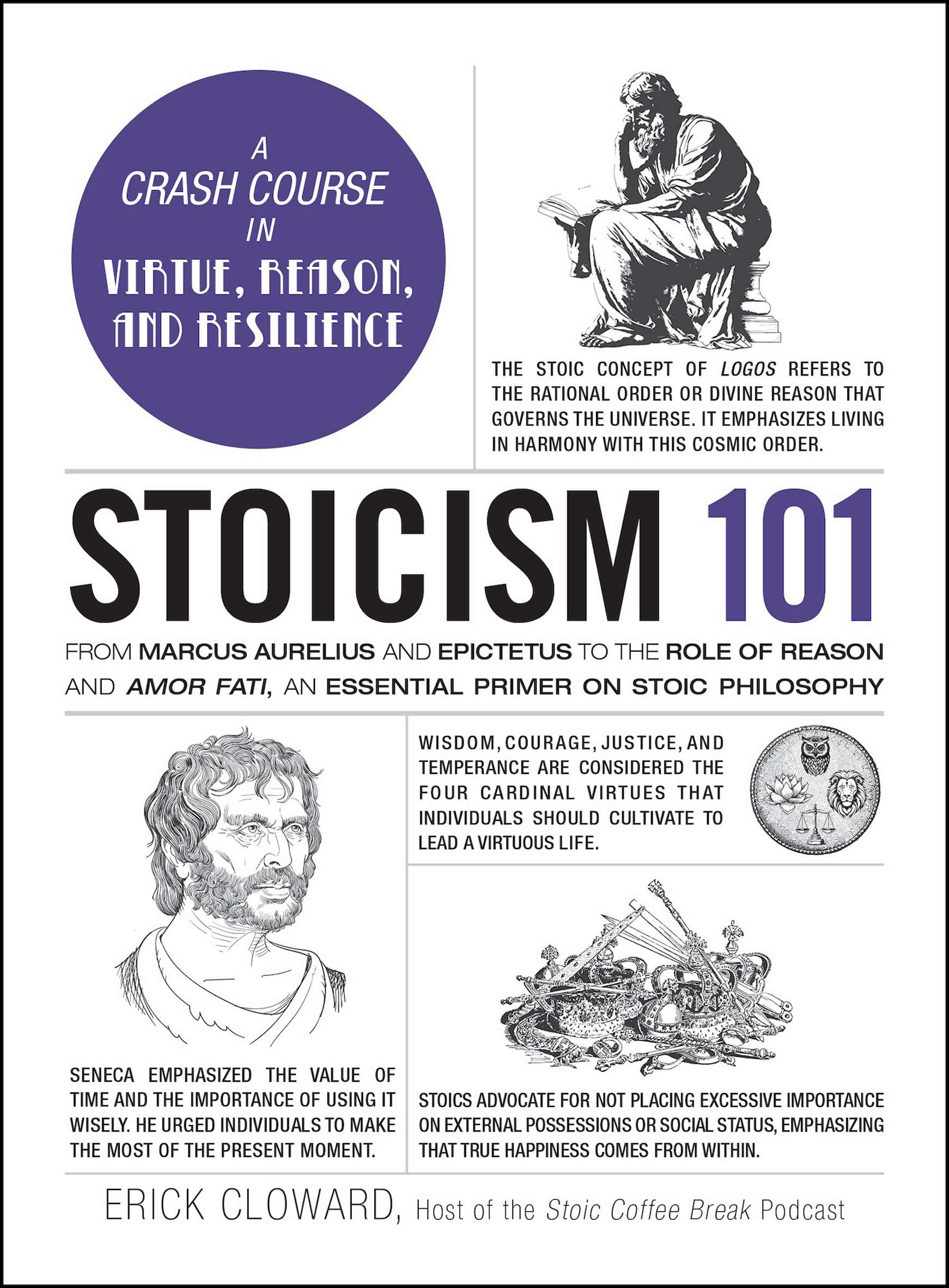
What this book is
A compact, accessible introduction to Stoic philosophy — its history, its founders, and its living toolkit. Erick Cloward (host of the Stoic Coffee Break podcast) wrote this book for people who want the ideas in a form they can actually apply to Monday morning, not just to ancient Rome. The result is 60 short chapters: each one stands on its own, each one connects to the next.
The book trades academic depth for reach and practicality. You do not need a philosophy background. You will finish it with a working vocabulary for the ideas — eudaimonia, apatheia, logos, memento mori — and a set of practices that the Stoics themselves actually used.
The shape of the argument
Read it as: the book spirals outward — from the Stoic tradition and its founders, through core doctrine (virtue, control, perception), into the emotional and social territories where the doctrine gets tested, and finally into the daily practices that make Stoicism a lived philosophy rather than a historical curiosity.
Executive summary
Stoicism is a philosophy built on one radical claim: the only things that are truly good or bad are the things inside your own character. Wealth, reputation, health, other people’s behavior — these are “indifferent,” meaning they are neither good nor bad in themselves. What is good is virtue (wisdom, courage, justice, temperance); what is bad is vice. Everything else is material to work with.
From that premise, all of Stoicism’s practical advice follows:
The dichotomy of control
The most used Stoic tool. Epictetus divided reality into two domains: what is “up to us” (our judgments, desires, aversions, impulses) and what is “not up to us” (our body, reputation, property, other people). Directing effort exclusively at the first column and releasing the second is what produces tranquility. Not resignation — active engagement with what is up to us, radical acceptance of what is not.
The four virtues
The Stoics held that all virtue is one — it cannot be split — but described it in four dimensions: wisdom (knowing what is truly good), courage (acting on that knowledge when it is hard), justice (acting rightly toward others), temperance (maintaining proportion and self-control). Character, in Stoic thought, is virtue applied consistently over time.
Logos and living according to nature
The Stoics believed the universe is pervaded by logos — rational order, the principle that makes things intelligible. To live according to nature, for a human being, means to live according to reason: to develop our distinctively rational capacities, to act for the common good, to accept what we cannot change while doing what we can. This is not an instruction to “go outside” — it is a claim about what human beings are built for.
Emotion: apatheia, amor fati, memento mori
Three ideas that sound harsh but are not. Apatheia is not apathy — it is freedom from irrational passions, not freedom from feeling. Amor fati (love of fate) is the active choice to embrace what happens, including adversity, as the material of a good life. Memento mori (remember you will die) is a practice of mortality awareness that clarifies what actually matters. Together these tools counteract the anxious clinging to outcomes that makes most suffering self-generated.
Who this is for
Read this if you want to:
- Understand where Stoicism came from and why Zeno, Seneca, Epictetus, and Marcus Aurelius say quite different things from the same tradition.
- Get a practical vocabulary — dichotomy of control, virtue, logos, apatheia, amor fati — that lets you read deeper Stoic texts with a head start.
- Apply Stoic tools to a specific problem: anger, anxiety, comparison with others, criticism, grief, or the fear of death.
- Build a daily practice — morning and evening reflection, negative visualization, memento mori — without it feeling like a self-help gimmick.
- Understand why Stoicism has lasted 2300 years and keeps reappearing in cognitive behavioral therapy, executive coaching, and military training.
How to read these summaries
Each chapter follows the same structure: core idea → why it matters → key takeaways → mental model (Mermaid diagram) → practical application → worked example → related lessons. The chapters are short — the book was written to be read one topic at a time. The same is true of these summaries.
Chapters 1–7 (tradition and thinkers) are useful context but not required. If you want to go straight to the philosophy, start at Chapter 8 (The Dichotomy of Control). If a Greek term confuses you, its definition chapter is never far away.
Chapter index
Concept companions
Jump to…
Type to filter; press Enter to open