Economics 101
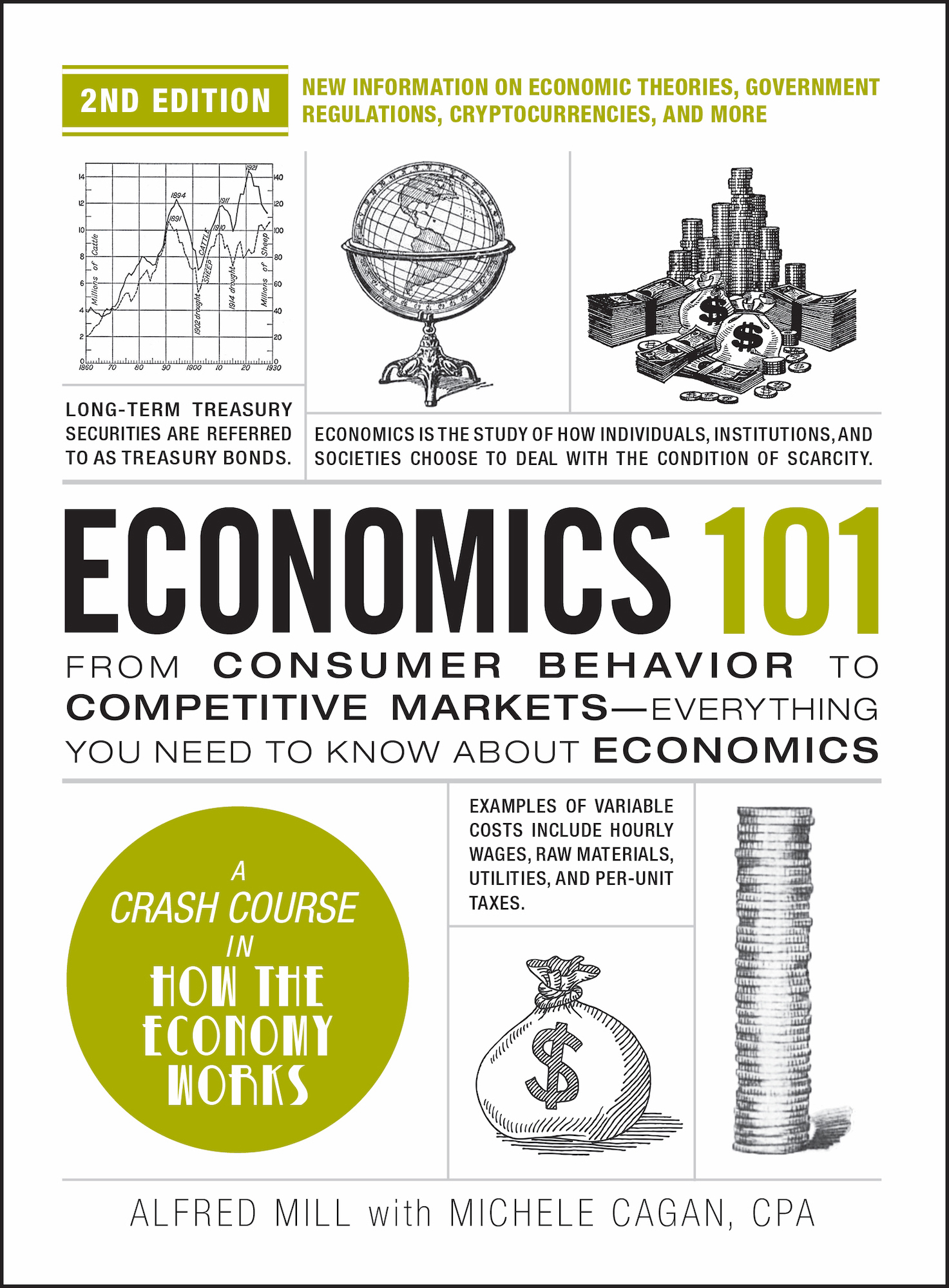
What this book is
A plain-language tour of how economists think. The authors strip the field down to a single recurring problem — scarcity forces choice — and then show how that one problem gives rise to prices, markets, money, banks, GDP, inflation, unemployment, business cycles, and the entire apparatus of macroeconomic policy. There are no equations to memorize. Instead you get the working vocabulary an informed citizen needs to follow business news, read a Fed announcement, or understand why your rent went up.
The shape of the argument
Read it as: The foundations (scarcity, trade-offs, comparative advantage, economic systems) feed every later arc. Money & Banking and Markets & Firms are the two micro engines. Financial Markets bridges micro and macro. The long final arc (chapters 35–61) is where it all becomes macroeconomics — GDP, inflation, unemployment, the Fed, fiscal policy, growth, and crises.
Executive summary
Economics is the study of how people, firms, and societies cope with scarcity. Once you accept that resources are finite and wants are not, three ideas do most of the work:
- Every choice has an opportunity cost — the value of the next-best thing you gave up. Decisions are never free, even when no money changes hands.
- Prices are signals, not arbitrary numbers. Supply and demand grind toward a price that clears the market; when the price moves, it is telling buyers and sellers something.
- Specialization plus exchange beats self-sufficiency. Comparative advantage means even the “worse at everything” party gains from trade — that single insight underwrites the global economy.
Layer money, banks, and government on top and you get a modern economy that can also break in modern ways: bubbles, panics, recessions, unemployment, inflation. The macro toolkit — fiscal policy from the legislature, monetary policy from the central bank — exists to dampen those failures, never to eliminate them.
Micro in one paragraph
A firm decides what to produce by comparing the marginal cost of one more unit to the marginal revenue from selling it. A consumer decides what to buy by comparing marginal utility to price. Markets coordinate these millions of decisions through prices. When markets work well, they allocate resources efficiently; when they fail (externalities, public goods, monopoly, information gaps), there is a case — not a guarantee — for government intervention.
Macro in one paragraph
Aggregate demand and aggregate supply set output, employment, and the price level. The Federal Reserve uses monetary policy (interest rates, the money supply) to lean against recessions and inflation. Congress and the President use fiscal policy (taxes and spending) to do the same on a slower clock. Both tools have side effects — debt, distortions, lags — and economists disagree on how aggressively to use them. The Keynesian, monetarist, and supply-side schools each emphasize a different lever.
Who this is for
Read this if you want to:
- Follow business and economic news without taking the analysts' framing on faith.
- Understand what the Fed is actually doing when it raises or lowers rates — and what trade-offs it is making.
- Know why supply shocks (oil, chips, labor) ripple through to prices, employment, and growth.
- Tell the difference between deficit, debt, inflation, and disinflation — and stop conflating them.
- Build a working mental model of the economy you can extend with more specialized reading later.
How to read these summaries
You do not have to read straight through. The book is organized so each chapter teaches one cleanly bounded idea. A few useful reading paths:
- The 60-minute intro: chapters 1, 2, 14, 16, 36, 45, 51, 53. Scarcity → markets → prices → GDP → inflation → the Fed → monetary policy.
- Microeconomics only: chapters 14–28.
- Money, banking, and finance: chapters 9–13, 29–34.
- Macro and policy: chapters 35–61, with 50 (Keynes) and 53 (monetary policy) as the keystones.
Each summary follows the same structure: core idea → why it matters → key takeaways → mental model (Mermaid diagram) → practical application → worked example → related material.
Concept companions
Jump to…
Type to filter; press Enter to open